

All-Natural Strawberry Jam (No Pectin)

Updated: Jun 13
Capture the Taste of Summer in a Jar.
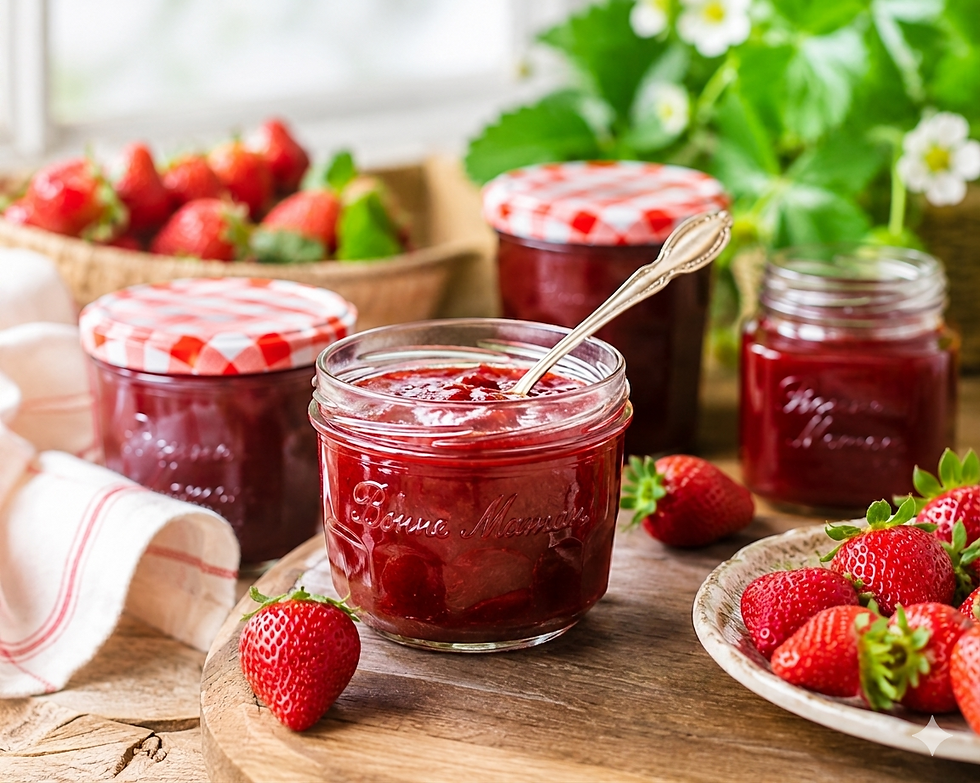
A naturally sweet strawberry jam made in the classic way, using only seasonal ripe fruit, sugar, and patience. No added pectin, no preservatives, just the pure taste of summer captured in a jar.
This is a simple recipe inspired by traditional homemade preserves, where fruit was treated with care and time was the most important ingredient.
The result is a beautifully fragrant jam with a soft, natural set and whole strawberries suspended in a ruby-red syrup.
It blends the rustic charm of old-fashioned countryside kitchens with a subtle French-inspired appreciation for seasonal fruit in its purest form. Just strawberries, sugar, and time. Nothing artificial, just real flavor.

The Taste of Traditional Homemade Jam
In many homes, jam-making was more than preservation, it was a ritual. Fruit was washed, trimmed, and left to rest overnight with sugar. The next day, everything was slowly simmered in large pots, with no rush and no strict rules; just instinct, patience, and experience passed down through generations.
This strawberry jam carries that same spirit:
simplicity
minimal ingredients
respect for the fruit
time as an essential ingredient
How Strawberry Jam Naturally Sets
✔ Natural pectin in strawberries: Strawberries contain pectin naturally. During cooking, this helps the jam thicken and set gently.
✔ The role of sugar: Sugar is not only for sweetness; it draws moisture from the fruit, stabilizes the natural pectin, and helps create the final texture.
✔ Lemon juice (acid balance): Lemon juice enhances pectin activity, helps preserve color, and prevents sugar crystallization.
✔ Slow simmering: As water evaporates, the syrup naturally thickens and develops a soft, glossy consistency without any additives.

Helpful Tips for Perfect Strawberry Jam
✔ Choose the best strawberries
Use fresh, ripe, and firm strawberries with a strong aroma. Medium or small berries are ideal. Very large strawberries tend to be watery and less flavorful.

✔ Slow maceration overnight (highly recommended)
For the best texture and color, let the strawberries rest with sugar for 6–12 hours (ideally overnight).
This process helps the fruit release its natural juices slowly, keeping the berries intact during cooking: beautiful, glossy, and almost jewel-like in the jar.
✔ Use a wide pan
A wide, shallow pot allows faster evaporation. This helps preserve the bright red color and reduces cooking time, preventing over-softening.
✔ Cold plate test
Before finishing, place a small plate in the freezer. Drop a bit of hot syrup onto it—if it wrinkles slightly when pushed, the jam is ready.
✔ Lemon is essential
Lemon juice enhances flavor, supports natural setting, and keeps the color vibrant. I usually use the juice of one lemon per 1 kg of strawberries, sometimes adding a little finely grated zest for a delicate citrus aroma.
✔ Slow simmering
As water evaporates, the syrup naturally thickens and develops a soft, glossy consistency without any additives

Sterilizing Jars and Lids
An essential step for any jam or preserve that needs to last through the winter is properly sterilizing the jars and lids. This ensures your jam stays safe, fresh, and full of its original flavor for months.
Before anything else, the jars should be thoroughly washed with hot water and dish soap, then rinsed very well to remove any traces of grease, detergent, or odor.
Simple and Effective Sterilization Methods
Oven method: Place the clean jars upright on a baking tray and heat them at 110–120°C for 10–15 minutes. This dries and sterilizes them evenly.
Boiling method: Submerge both jars and lids in boiling water for a few minutes. Carefully remove them and let them air-dry on a clean kitchen towel.
Steam method (traditional): A classic household technique: hold the jars over hot steam until condensation forms and sterilization is achieved. This method has been used for generations in home kitchens.
Sterilizing the Lids
Lids should be sterilized separately, usually by briefly boiling them for a few minutes. After that, let them air-dry naturally; do not wipe the inside, as this may reintroduce bacteria.
The Importance of Timing
For best results, fill the jars while they are still slightly warm, and pour in the jam while it is still hot. This combination helps create a natural vacuum seal, which protects the preserve and extends its shelf life.
Once sealed properly, your jam will stay beautifully preserved, maintaining its flavor, color, and texture over time.

Strawberry Jam: Ideal Sugar-to-Fruit Ratio
In traditional jam-making, strawberry preserves were often prepared in a 1:1 ratio of sugar to fruit, which ensured both a balanced sweetness and reliable preservation throughout the year.
In practice, however, this ratio can be gently adjusted depending on how sweet and ripe the strawberries are. Reducing the sugar too much may affect the texture, stability, and overall shelf life of the jam.
A well-balanced approach that works beautifully in most cases is around 750 g of sugar per 1 kg of strawberries (about 75%). This amount is enough to help the jam set properly while still allowing the natural flavor of the fruit to remain at the center.
It creates a preserve that feels rich yet balanced, where the strawberries remain vivid, fragrant, and gently shine through in every spoonful.

Lemon – a Small Secret of Balance and Aroma
I usually use the juice of one lemon per 1 kg of strawberries, which feels just right to balance the sweetness while keeping the fruit’s natural flavor bright and vibrant.
I also like to add a little finely grated lemon zest, letting it simmer along with the jam. As it cooks, it softens and gently candied in the syrup, adding a subtle, fragrant citrus note that beautifully enhances the strawberry aroma.
How to Make Traditional Strawberry Jam, Step by Step
Step 1: Quick washing
✔ Place the strawberries in a large sieve and rinse them quickly under cold running water.
✔ It is very important not to soak them in water for too long, as their porous texture will absorb liquid like a sponge, making the jam watery and harder to set.

Step 2: Cleaning and sizing (the secret to texture)
✔ Remove the green tops using a small knife or by gently twisting them off. If you find small strawberries (the ideal size), leave them whole.
✔ If the fruits are medium or large, cut them carefully into halves or quarters. Even pieces ensure even cooking.

Step 3: Layering and starting maceration (natural osmosis)
✔ Use a large pot, preferably with a thick base and a wide diameter. Add a layer of strawberries, then sprinkle a generous layer of sugar.
✔ Continue alternating layers (fruit, sugar) until all ingredients are used. The final top layer should always be sugar.
✔ Finish by evenly pouring lemon juice over the surface.

Step 4: Maceration – overnight (6–12 hours)
✔ Cover the pot with a clean cloth or lid and leave it in a cool place for at least 6 hours, ideally overnight (10–12 hours).
✔ During this time, through osmosis, the sugar draws out the natural juices from the strawberries. By morning, you will find the fruit floating in a rich red syrup, slightly firmer and ready to withstand cooking without breaking down into purée.
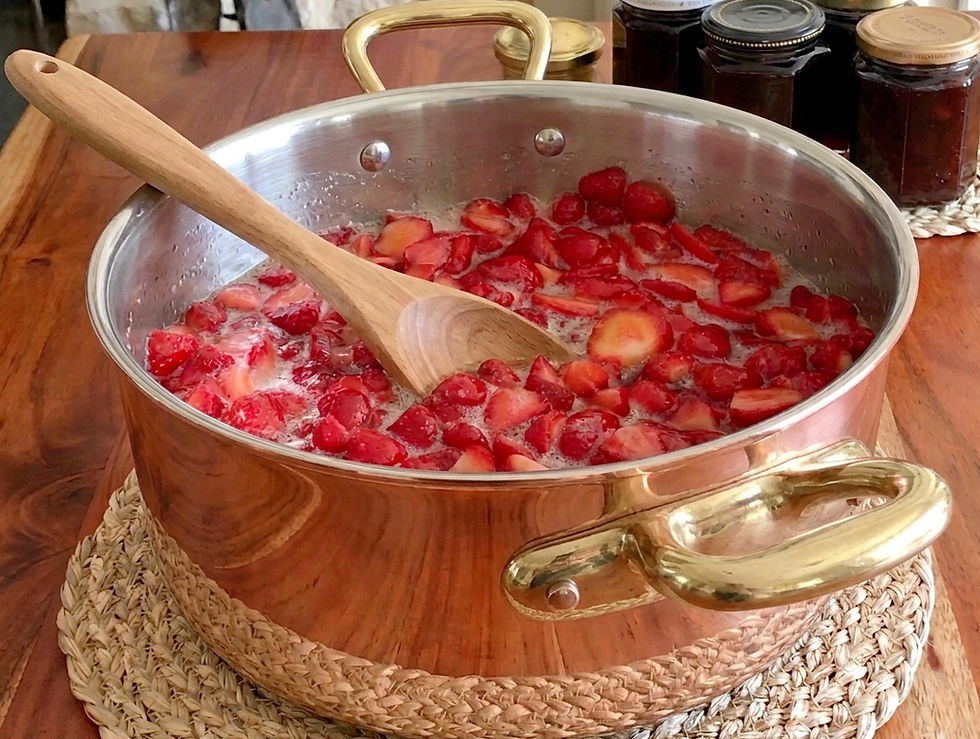
Step 5: Slow cooking and temperature control
✔ Place the pot over low heat at first, gently stirring with a wooden spoon until all sugar crystals have completely dissolved.
✔ Once dissolved, increase to medium heat and let the jam simmer steadily but gently.
✔ There is no need to stir constantly; just occasionally and very gently, or simply swirl the pot to keep the strawberries whole and beautiful.

✔ During cooking, a thick pinkish foam will rise to the surface. This contains trapped air and natural impurities from the sugar.
✔ Using a skimmer or a large spoon, carefully remove the foam, gently pushing it to the edges of the pot and discarding it.
✔ Repeat this process a few times. Proper skimming ensures a clearer, more luminous jam and helps prevent fermentation during storage.

Step 7: Cold plate test (checking consistency)
✔ Before turning off the heat, place a small plate in the freezer for a few minutes.
✔ Drop 2–3 spoonfuls of hot syrup onto it. Let it cool for a minute, then gently push it with your fingertip.
✔ If it wrinkles slightly and holds its shape like a soft jelly, the jam is ready.
✔ Turn off the heat immediately.

Step 8: Hot filling and vacuum sealing
✔ Jars and lids should be pre-washed and sterilized in the oven and kept warm.
✔ Pour the boiling hot jam into the jars, leaving about 1 cm of space at the top. Seal tightly.
✔ Filling the jars while the jam is still hot helps create a natural vacuum, preventing mold and extending shelf life.
✔ Make sure the jars are filled evenly, without air pockets, for proper preservation.

✔ To ensure a perfect seal, turn the hot jars upside down for 5–10 minutes. This simple trick sterilizes the remaining air at the top and strengthens the vacuum.

✔ Turn them back upright and wrap them in a thick blanket until completely cooled (24–48 hours).
✔ Shelf life: Properly made and sealed jam can last in excellent condition for 12–18 months. While it can still be eaten after that, the flavor and texture gradually decline over time.

Frequently Asked Questions (FAQ)
Question | Answer |
What happens if I don’t add pectin? | There’s no problem if you skip pectin. Strawberries naturally contain pectin, and when combined with sugar, acidity, and slow cooking, the jam sets naturally. The result is a softer, slightly syrupy texture rather than a firm jelly; but this is exactly the traditional, authentic style. |
Is maceration necessary? | It is not strictly required, but highly recommended. If you skip maceration and cook the strawberries directly, they will soften quickly, break down more easily, and release more liquid. The result will be closer to a jam rather than a traditional whole-fruit preserve. |
Can I reduce the sugar? | Yes, but only slightly. Sugar is important for both flavor and preservation. A balanced ratio is around 750 g sugar per 1 kg of strawberries. |
Why does foam form during cooking? | The foam is made of natural impurities from the fruit and trapped air. Skimming it off helps achieve a clearer, cleaner jam with better texture and shelf life. |
How do I know when the jam is ready? | Use the cold plate test: drop a small amount of syrup onto a chilled plate. If it thickens and wrinkles slightly when pushed, the jam is ready. |
Can I use frozen strawberries? | Yes, but the flavor and texture will be slightly less intense compared to fresh seasonal strawberries. |
Love this recipe? Please leave a comment. Your feedback, suggestions, and adaptations are very helpful to other bakers!

All-Natural Strawberry Jam
(No Pectin)
Made without added pectin, the jam develops its texture naturally through slow maceration and gentle simmering, resulting in a rich, glossy syrup with whole, tender strawberries throughout.
Yield: 4–5 jars (250 g each) | Prep: 35 min | Maceration: 10–12 h | Cook: 25–40 min |
Total: 12–13 h
Ingredients
1 kg ripe strawberries
750 g sugar
Juice of 1 lemon
Optional: finely grated lemon zest
Method
Gently wash the strawberries and remove the green tops. Leave them whole or cut into even pieces depending on size.
Combine strawberries with sugar and lemon juice. Cover and let rest in the refrigerator for 10–12 hours, allowing the fruit to release its natural juices.
Transfer to a large pot and cook over low to medium heat for 25–40 minutes, stirring gently and skimming off any foam that forms on the surface.
If using, add lemon zest during cooking for a subtle citrus aroma.
To check doneness, place a small spoonful of jam on a cold plate. If it wrinkles slightly when pushed, it is ready.
Pour hot jam into sterilized jars, seal tightly, and let cool completely.
Enjoy!
Notes |
1. For best results, use ripe but firm strawberries and avoid skipping the maceration step, as it helps preserve fruit shape and creates a clearer syrup.
2. Cook gently to maintain color, flavor, and natural texture.

Have you tried making this Strawberry Jam? I'd love to hear about your experience! Share your thoughts and any creative twists you added to the recipe in the comments below. Or, tag me on Instagram (@FeliChic'Cuisine) when you post your recipe creations. Let's inspire each other. Thank You!





Comments